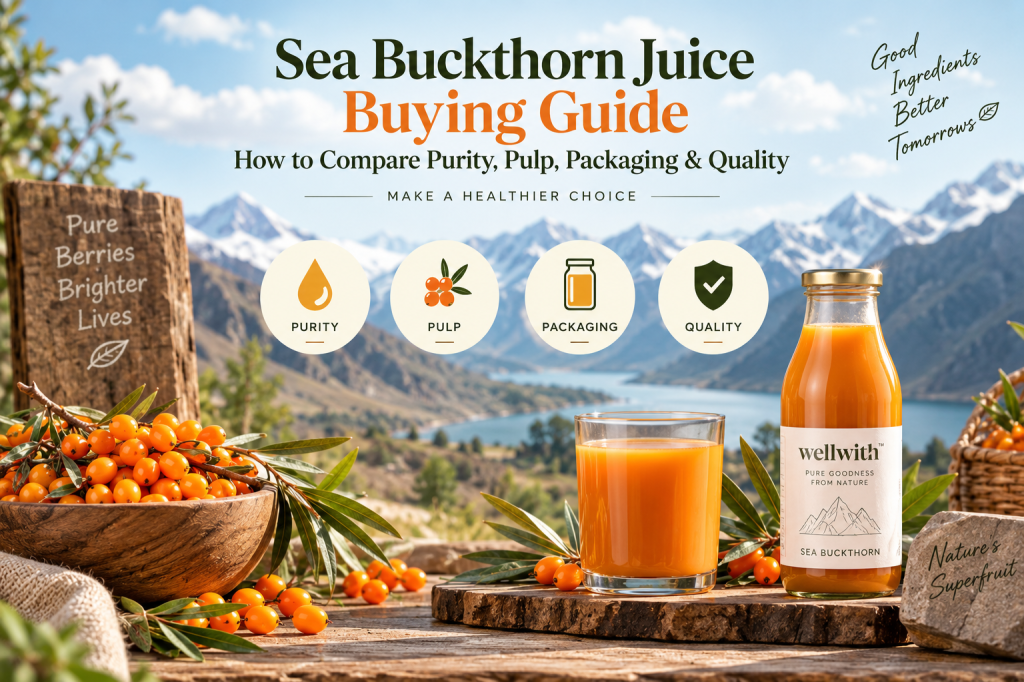
Sea buckthorn juice has become increasingly popular as consumers look for nutrient-rich, plant-based wellness products. But with more brands entering the market, comparing one product with another can be difficult.
Terms such as “pure pulp,” “pulp concentrate,” “lab-tested,” “cold-pressed,” “natural,” and “Himalayan sea buckthorn” can appear on product pages, but what do they actually tell you about the product?
Before buying a sea buckthorn juice, it is worth looking beyond the front label and checking the ingredient information, processing method, packaging, testing information, sourcing and transparency.
Here’s what to look for.
5 Things to Consider Before Buying Sea Buckthorn Juice
1. Check What Is Actually Inside the Bottle
One of the first things to check is the ingredient list.
A product page may describe a juice as “pure,” “natural,” or “pulp concentrate,” but the ingredient declaration gives you more useful information about what the manufacturer says is actually in the product.
Look for information such as:
- Sea buckthorn pulp or juice
- Pulp concentrate
- Added water
- Added sugar or sweeteners
- Preservatives
- Flavours or colours
- Other fruit juices or ingredients
The more clearly a brand explains its formulation, the easier it is for consumers to compare products.
Don’t judge purity from marketing language alone
For example, NutriOrg currently describes its product as 99.98% pure pulp concentrate and says it is made with nearly pure juice pulp.
Fytika describes its product as a pulp concentrate and provides a dedicated “Main Ingredients” section identifying sea buckthorn fruit pulp.
Therefore, rather than assuming that a brand is hiding its formulation because an ingredient graphic isn’t displayed, check the actual ingredient declaration and product documentation.
2. Understand “Pulp” vs. “Pulp Concentrate”
This is particularly important when comparing sea buckthorn products.
What is pulp concentrate?
A concentrate is produced by processing juice or pulp to remove some of its water, resulting in a more concentrated material.
It may subsequently be reconstituted or diluted depending on the final formulation.
Therefore:
“Pulp” and “pulp concentrate” are not automatically the same thing.
The important questions are:
- What percentage of the product is pulp?
- Is it concentrated?
- Is water added?
- What processing method is used?
- Is the product diluted before consumption?
- Does the manufacturer clearly disclose the formulation?
This is much more useful than simply choosing whichever product uses the word “pure.”
3. Look for Transparent Lab-Testing Information
“Lab-tested” can be a useful quality signal, but consumers should ideally be able to understand what was tested and who performed the testing.
Look for:
- Laboratory name
- Certificate/report number
- Testing parameters
- Testing date
- FSSAI or relevant regulatory information
- Downloadable certificate/report where available
The key takeaway is simple:
Don’t rely on the words “lab-tested” alone. Look for supporting documentation where available.
4. Consider the Packaging
Sea buckthorn products are naturally acidic, so packaging deserves consideration.
However, the presence of a plastic bottle does not by itself prove that a product is unsafe or poisonous. Packaging safety depends on the material, formulation, storage conditions, regulatory compliance and migration characteristics.
Instead of making an unsupported safety claim, consumers can ask:
Does the brand clearly explain the packaging material and its suitability for the product?
Glass packaging can also offer advantages from a consumer-perception and premium-positioning perspective, particularly for products marketed around purity and natural ingredients.
5. Don’t Compare Products Only by Price
Price is useful, but price alone doesn’t tell you the quality or purity of a sea buckthorn juice.
For example, current listed prices vary considerably across brands and pack sizes. NutriOrg currently lists its 500 ml pack at ₹599, while Kapiva lists its 500 ml pack at ₹649 on its own website. Fytika currently lists its 300 ml pack at ₹699.
Instead of asking:
“Which one is cheapest?”
compare:
Price → Quantity → Pulp/concentration → Ingredients → Testing → Processing → Packaging → Sourcing
This gives you a much more meaningful comparison.
What We Found While Comparing Sea Buckthorn Juice Brands
We reviewed several sea buckthorn juice products based on publicly available product information.
NutriOrg
NutriOrg currently states that its Sea Buckthorn Juice contains 99.98% pure pulp concentrate in a plastic bottle.
What to compare:
Pulp concentration, processing method, testing documentation and packaging.
Fytika
Fytika describes its product as a pulp concentrate and currently provides information about certifications, lab testing and its main ingredient, sea buckthorn fruit pulp.
What to compare:
Concentration, testing documentation, sourcing and formulation.
Krishna’s Herbal & Ayurveda
The product page currently lists the 500 ml product at ₹513 and describes it as made from freshly harvested Leh-Ladakh berries. It also states that the product is cold-pressed and not an extract or concentrate. The page currently shows the product as sold out.
What to compare:
Fresh-berry juice vs. concentrate, processing method, availability and supporting documentation.
VedBerry
VedBerry currently describes its product as sea buckthorn juice/pulp and makes claims around natural ingredients, omega fatty acids and vitamin C. Its product page also states that the juice is cold-pressed and minimally processed.
What to compare:
Ingredient composition, processing, testing information and sourcing.
Kapiva
Kapiva currently describes its Sea Buckthorn Juice as being made with berries sourced from high-altitude Ladakh and says it contains no added sugar, colours or flavours but comes in plastic bottle pack. Its website lists the 500 ml pack at ₹649, while a Blinkit listing identifies the ingredient as Sea Buckthorn Pulp.
What to compare:
Ingredient disclosure, pulp/concentration, testing information and packaging.
What Makes WellWith Sea Buckthorn Juice Different from Other Brands Available Online?
When evaluating WellWith, the same criteria should be applied: ingredient transparency, processing, sourcing, testing and packaging.
WellWith uses Sea Buckthorn pulp concentrate, and the product is positioned around concentrated pulp rather than simply describing the product as a generic fruit drink.
Pulp vs. Pulp Concentrate
A useful distinction is:
| Label | What it generally indicates |
|---|---|
| Pulp | Fruit pulp used as an ingredient |
| Pulp concentrate | Pulp processed to remove some water and increase concentration |
| 99.9% pulp concentrate | A formulation claim indicating a very high proportion of the concentrate, subject to the product’s actual formulation |
Important: “99.9% pulp concentrate” should not automatically be interpreted as “99.9% whole fresh berries.” Concentration and purity are related but different concepts.
Why Transparency Matters More Than Marketing Words
When buying sea buckthorn juice, don’t choose a product simply because it says:
Pure. Natural. Premium. Himalayan. Lab-tested.
Instead, look for the evidence behind those words.
A transparent brand should make it reasonably easy to understand:
- What is in the bottle?
- How is it processed?
- Where are the berries sourced?
- What testing has been performed?
- What type of packaging is used?
- How should the product be consumed?
That’s a much better way to compare sea buckthorn juices.
Final Verdict: What Should You Look For?
There isn’t one single factor that determines whether a sea buckthorn juice is the right choice.
Instead, compare the complete product story:
Ingredient transparency + pulp/concentration + processing + testing + sourcing + packaging + price
For WellWith, this provides an opportunity to communicate its pulp-concentrate formulation, Ladakh sourcing, testing, processing and glass packaging clearly rather than simply claiming that competing products are inferior.
WellWith Sea Buckthorn Juice can then be positioned around transparency and product quality, allowing consumers to make an informed comparison.
Also Read: Best Sea Buckthorn Juice Brand in India
 WellWith - Sea Buckthorn
Leave a comment